


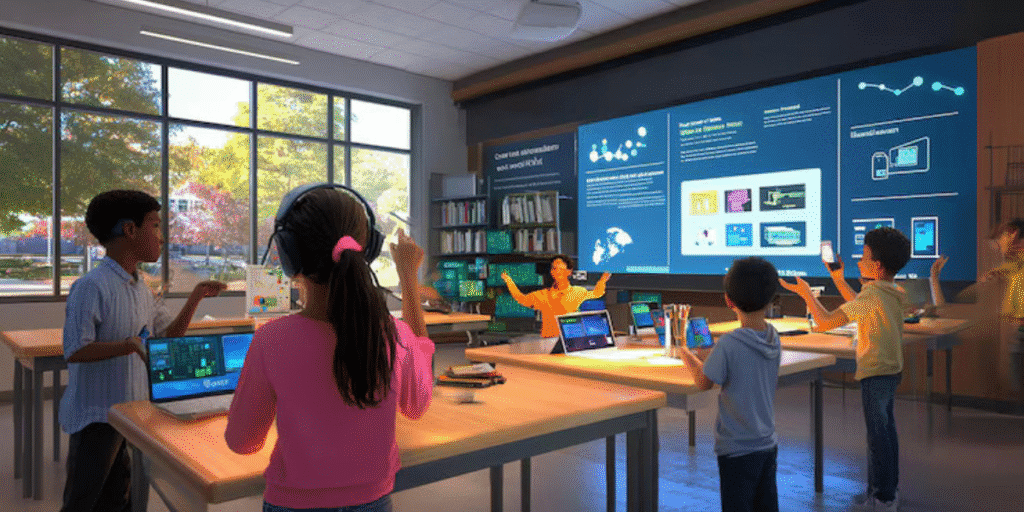
Walk into a typical Indian classroom a decade ago and you’d see dusty blackboards, chalk, and rows of students copying notes. Walk into many Indian classrooms today, and you’ll find something very different: a bright, touch‑enabled smart board that looks more like a giant tablet than a traditional board.
This change is not just cosmetic. Smart boards are quietly reshaping how Indian students learn, how teachers teach, and how schools connect with the digital world. Here’s how.
1. From “Chalk and Talk” to “Touch and Learn”
For years, Indian classrooms largely followed one pattern: the teacher writes, explains, and students listen and copy. Smart boards are breaking that routine.
- Interactive lessons: Instead of drawing rough diagrams by hand, teachers can open 3D models, animations, and videos. A biology teacher can zoom into a beating heart; a geography teacher can rotate a 3D globe and show live weather patterns.
- Student participation: Students come to the board to solve sums, label diagrams, drag and drop answers, or even present their own small projects. Learning becomes something they do, not just something they hear.
This shift from passive listening to active participation is especially powerful in large Indian classrooms, where it’s easy for quieter students to disappear into the back benches.
2. Making Complex Concepts Simpler – In Any Language
India’s diversity of boards (CBSE, ICSE, state boards), languages, and syllabi can make teaching complex. Smart boards are helping teachers simplify difficult topics and reach more learners.
- Visual explanations: Fractions, algebra, chemical reactions, and physics laws become easier with animations and step‑by‑step visual breakdowns.
- Multilingual support: Digital content is increasingly available in regional languages—Hindi, Marathi, Tamil, Bengali, Kannada, Telugu, Gujarati, and more. Teachers can switch between languages or show bilingual content, helping first‑generation learners and students from non‑English backgrounds.
- Audio‑visual reinforcement: Pronunciation in English, explanation in the local language, and visual demonstration on the same screen—this triple combination is a game changer for comprehension.
For many students who struggle with textbook‑only teaching, smart boards make abstract ideas concrete and memorable.
3. Bridging the Urban–Rural Gap (Slowly but Surely)
There’s still a big difference between a metro city school and a village school—but smart boards are starting to narrow that gap.
- Same quality content, different locations: A rural government school with a smart board and internet access can show the same high‑quality science animation that a private school in Bengaluru or Delhi uses.
- Recorded expert sessions: A physics lecture from a top teacher in one city can be recorded and played in dozens of schools across the country.
- Offline content for low‑network areas: Many smart board solutions now allow schools to store content offline on the device. This means even if internet is unstable, lessons, videos, and quizzes still work.
While infrastructure challenges remain, smart boards are one of the first tools that genuinely offer rural students access to content that was once limited to premium urban schools.
4. Empowering Teachers, Not Replacing Them
There’s a common fear: “Will technology replace teachers?” In Indian classrooms, the opposite is happening—smart boards are helping teachers do more, in less time.
- Ready‑made resources: Instead of drawing the same diagram 10 times a year, teachers can open a pre‑created slide, annotate it, save it, and reuse it.
- Easy lesson planning: Teachers can store all their chapter‑wise notes, videos, and examples in folders on the board. Each year, they refine and improve the same digital lesson, rather than starting from scratch.
- Instant adaptation: If students don’t understand a concept, teachers can quickly search for another video, another example, or a simpler diagram to clarify on the spot.
In many Indian schools, where teachers handle large classes and multiple sections, this efficiency is not a luxury—it’s survival. Smart boards act like a digital teaching assistant that’s always ready with visuals and explanations.
5. Turning Classrooms into Collaboration Spaces
Indian classrooms have often been exam‑focused and teacher‑centric. Smart boards are nudging them towards discussion and collaboration.
- Group problem‑solving: Students can come to the board in teams, solve puzzles, answer quiz questions, or work through a maths problem together.
- Brainstorming and projects: For higher classes, smart boards are being used to plan projects, create mind maps, and discuss real‑world problems—from climate change to startup ideas.
- Presentation skills: Students learn to present in front of the class using slides, videos, and digital tools—skills they’ll need in college and the workplace.
This collaborative use of smart boards encourages students to ask questions, explain to each other, and think beyond “what is the right answer?” to “why is this the right answer?”
6. Supporting Inclusive Education
Indian classrooms are often mixed‑ability: fast learners, slow learners, children with learning difficulties, and sometimes children with physical or sensory challenges. Smart boards can make learning more inclusive.
- Visual + audio support: Students who struggle with reading can benefit from images and audio explanations.
- Zoom and highlight: Teachers can zoom into text, increase font size, or highlight key points for students with visual difficulty or concentration issues.
- Replay and revision: Lessons can be saved and revisited. Students who need extra time can go through the same explanation again, without feeling left behind.
While inclusion requires more than technology alone, smart boards give teachers flexible tools to adjust lessons to different needs.
7. Connecting Classrooms to the Real World
One of the most exciting changes smart boards bring to Indian classrooms is the ability to bring the outside world inside.
- Virtual field trips: A school in a small town can virtually “visit” a museum in London, a space centre in the US, or a wildlife reserve in Africa.
- Live news and current affairs: Civics or economics classes can use live graphs, budget speeches, election maps, and news clips to discuss real events, not just textbook theories.
- Industry exposure: Videos about factories, farms, startups, and labs give students a sense of how concepts they learn are used in real jobs and businesses.
For many Indian students who may not travel or have limited exposure outside their town or village, the smart board becomes a window to the world.
8. Data, Exams, and Smarter Assessment
Indian education is highly exam‑driven. Smart boards are slowly transforming assessment from just “marks at the end” to continuous feedback.
- Instant quizzes and polls: Teachers can run quick quizzes during class. Results appear immediately, showing which concepts are clear and where students are stuck.
- Game‑based learning: Subjects like maths and grammar can be practiced through interactive games and leaderboards, making practice less stressful and more engaging.
- Performance tracking: When linked with school software, smart boards can help track which topics are frequently problematic, helping schools plan targeted revision sessions.
This kind of real‑time insight is especially useful in crowded Indian classrooms where individual attention is hard to manage.
9. Challenges on the Ground – and How Schools Are Solving Them
The transformation is not perfect or uniform. Indian schools face real constraints:
- Budget limitations: Not every school can afford a smart board in every classroom. Many start with a few rooms (like computer labs, senior classes, or demo rooms) and expand slowly.
- Training gaps: Some teachers are initially hesitant or unsure how to use the technology. Schools that invest in ongoing training and peer sharing see far better usage.
- Power and internet issues: Especially in rural or semi‑urban areas, power cuts and weak connectivity are common. Here, solutions like offline content, battery backups, and local storage are making a difference.
Despite these challenges, the trend is clear: year after year, more Indian schools are adding smart boards and learning how to use them effectively.
Conclusion
Smart boards are not just fancy screens in Indian classrooms—they are catalysts for change. They are:
- Turning lectures into interactive learning experiences
- Making complex ideas simpler and more visual
- Bringing urban‑level content to rural schools
- Empowering teachers with better tools and resources
- Helping students collaborate, question, and present
- Opening a window from the classroom to the larger world
India’s education system is vast and diverse, and no single tool can solve all its challenges. But smart boards are proving to be one of the most practical, visible steps towards more engaging, modern, and inclusive classrooms.


