


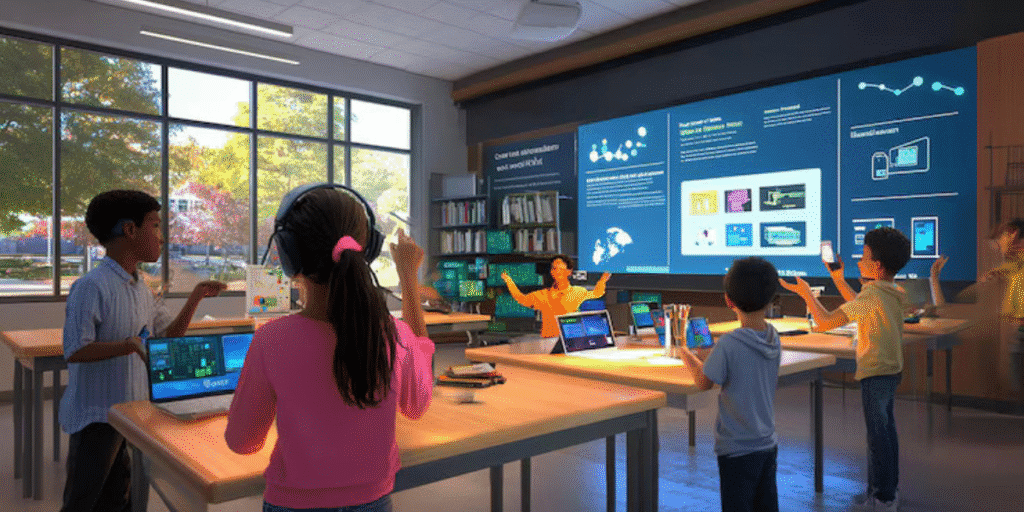
Walk into any modern classroom today and you’ll likely find a sleek smart board where a chalkboard once stood. At first glance, it may just look like a big touchscreen, but the impact it has on how students learn—and how well they perform—is far deeper. Smart boards are not just upgrading classrooms visually; they are transforming student learning outcomes in measurable and meaningful ways.
From Listening to Doing: Active Learning That Sticks
For decades, classrooms have relied on a “talk and chalk” model—teachers explain, students listen and copy. Smart boards flip this script by turning lessons into hands-on experiences.
- Students can solve math problems directly on the board, move shapes, draw graphs, and visually see how equations change.
- In science, they can drag and drop labels onto diagrams, simulate experiments, or rotate 3D models of molecules and organs.
- In language classes, they can rearrange sentences, highlight grammar patterns, and annotate passages together.
This kind of active learning does more than make lessons fun; it improves retention and understanding. When students physically interact with content, they are more likely to remember it and apply it correctly in tests, projects, and real-life situations.
Visual, Auditory, and Kinesthetic: Reaching Every Type of Learner
Every classroom has a mix of learners: some understand best by seeing, others by hearing, and some by doing. Traditional teaching methods often favour one style over the others. Smart boards help level the playing field.
- Visual learners benefit from charts, videos, images, and diagrams displayed in high resolution.
- Auditory learners gain from integrated audio, pronunciation tools, and video explanations.
- Kinesthetic learners engage through touch, movement, and interactive games.
When more students can learn in a way that matches their natural style, overall class performance improves. Concepts that once felt abstract—like fractions, grammar rules, or scientific processes—become concrete and understandable.
Real-Time Feedback: Closing Learning Gaps Faster
One of the biggest advantages of smart boards is the ability to give instant feedback.
- Teachers can run quick quizzes, polls, or interactive exercises on the smart board.
- Students respond using their devices or by coming up to the board.
- Results appear immediately, showing who has understood and who needs help.
Instead of waiting for a weekly test or homework correction to discover misunderstandings, teachers can spot learning gaps during the lesson itself. They can re-explain a topic, show another example, or adjust the pace on the spot. This real-time correction leads to fewer repeated mistakes and stronger exam performance.
Facilitating Collaboration and Communication Skills
Smart boards are powerful tools for collaborative learning, which is strongly linked to better outcomes in critical thinking and problem-solving.
- Groups can work together on mind maps, project plans, and case studies on the board.
- Students can present their ideas, annotate slides, and explain solutions to the class.
- The teacher can capture these sessions and save them as notes for later revision.
This style of learning develops not only subject knowledge but also communication, teamwork, and confidence—skills that influence long-term academic and career success.
Making Abstract Concepts Concrete with Multimedia
Some topics are naturally difficult to grasp through text alone. Smart boards bridge this gap with rich multimedia content.
- A history lesson can include timelines, archival videos, and interactive maps.
- A physics concept like motion or electricity can be demonstrated with animations and simulations.
- Language classes can use audio clips, dialogues, and pronunciation tools to improve speaking and listening.
When students can see, hear, and manipulate information, they develop a deeper understanding. This deeper understanding translates into better scores on conceptual questions, not just rote memorisation.
Supporting Differentiated and Inclusive Learning
Not all students move at the same speed, and some need more support than others. Smart boards help teachers differentiate instruction without isolating students.
- Teachers can prepare multiple levels of activities—basic, intermediate, and advanced—and switch between them seamlessly.
- Features like zooming, high-contrast modes, subtitles, and audio support help students with visual, auditory, or learning difficulties.
- Lessons can be recorded or saved so that students who need more time can review at their own pace.
This inclusive approach reduces frustration and boosts confidence, leading to better overall performance across the entire class, not just among top performers.
Stronger Engagement, Better Attendance, Better Results
Student engagement is closely linked to attendance and academic performance. When lessons are interactive, dynamic, and relevant, students are more likely to show up, participate, and stay focused.
- Gamified quizzes, interactive puzzles, and live polls on the smart board make lessons feel like challenges rather than chores.
- Real-world examples—news clips, industry videos, live data—help students see why the subject matters, increasing motivation.
- Teachers can easily revisit previous lessons, connect topics, and show the “big picture,” which helps students build long-term understanding instead of cramming.
Over time, this consistent engagement leads to higher grades, better project quality, and stronger exam outcomes.
Data-Driven Teaching: Smarter Decisions, Better Outcomes
Many smart board ecosystems integrate with educational software and learning platforms that track student performance over time.
- Teachers can view data on which questions most students got wrong, which topics cause difficulty, and which activities lead to better results.
- This data allows them to refine lesson plans, adjust teaching strategies, and provide targeted support to individuals or groups.
Instead of guessing what works, teachers can rely on evidence-based decisions, which directly improves learning outcomes.
Preparing Students for a Digital Future
Smart boards don’t just improve current test scores; they also prepare students for the technology-rich world they will enter after school.
- Students become comfortable with touch interfaces, digital tools, and online resources.
- They learn to present information digitally, collaborate on shared screens, and use multimedia to communicate ideas.
- These skills are critical in higher education and modern workplaces.
By integrating smart boards into everyday learning, schools are not only boosting immediate academic performance but also equipping students with future-ready skills.
Conclusion
Smart boards are changing student learning outcomes in multiple, interconnected ways. They turn passive listeners into active learners, support different learning styles, provide instant feedback, encourage collaboration, and make abstract concepts easier to grasp. They also enable inclusive, data-driven teaching and help students build digital skills for the future.
When thoughtfully integrated into the classroom, smart boards do much more than modernize the look of a lesson—they elevate the quality of learning itself, leading to stronger understanding, higher engagement, and better academic results.


