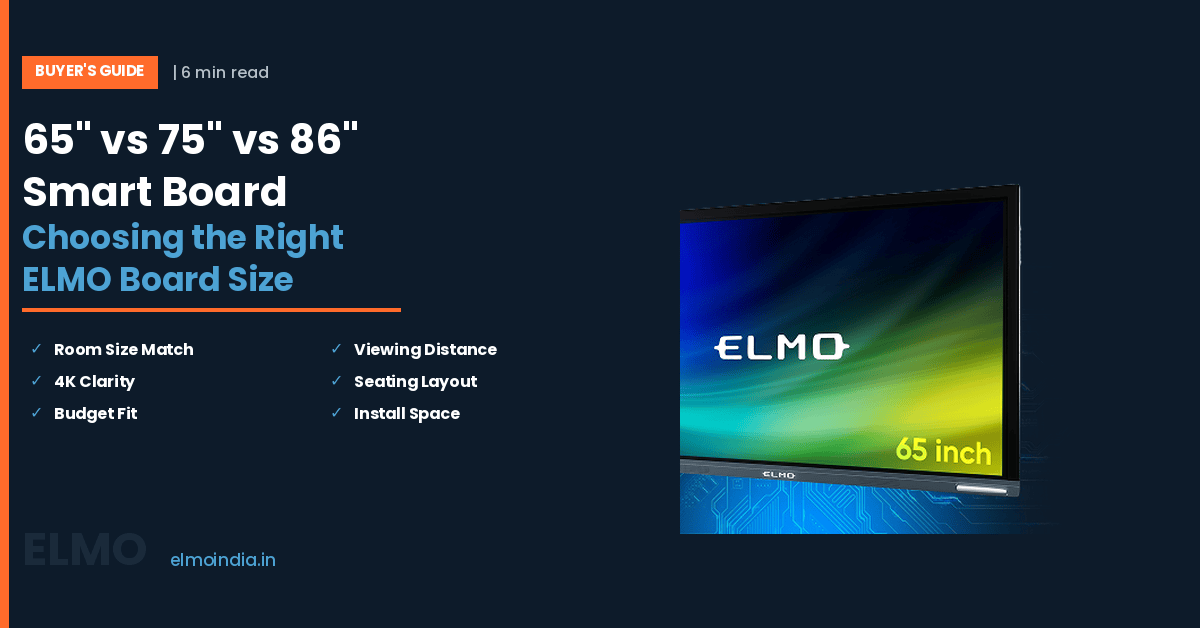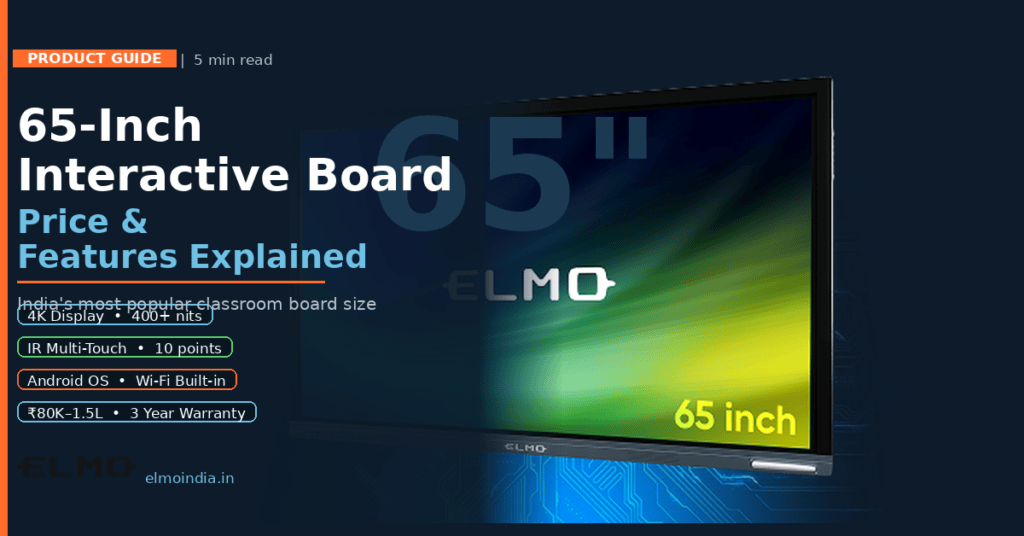
Among all the sizes available in the market, the 65-inch interactive board has become the most installed classroom display in India. It hits a practical balance that no other size matches: large enough to be visible from 8–9 metres away, compact enough to fit the front wall of a standard classroom, and priced within reach of most school budgets. If your school is evaluating a 65-inch interactive board purchase, this guide explains what you should expect to pay, what features come at each price point, and whether a 65-inch board is the right fit for your specific classroom needs.
What Does a 65-Inch Interactive Board Cost in India?
In India, 65-inch interactive boards are priced between ₹80,000 and ₹1,50,000 for mid-range models with the features most schools need: Full HD or 4K display, Android OS, infrared multi-touch, built-in speakers, and Wi-Fi. Premium 65-inch boards with dual OS, higher touch point counts, or 4K display with advanced processor can push towards ₹1,50,000–1,80,000.
Entry-level 65-inch boards at ₹70,000–85,000 exist but often sacrifice important features: lower resolution, weaker touch response, or limited warranty. For a classroom board used 5–8 hours daily, the ₹90,000–1,30,000 range is the practical sweet spot — boards in this range have been field-tested across thousands of Indian classrooms and offer the right combination of durability and features.
For a full picture of what drives pricing, read our interactive whiteboard price guide by size and technology.
Core Features to Expect in a Quality 65-Inch Board
Not all 65-inch boards deliver the same experience. Here are the features that define a well-specified board at this size:
Display panel: IPS or VA panel with 400+ nits brightness. IPS offers better wide-angle viewing — important in classrooms where students sit to the sides. A minimum contrast ratio of 1200:1 keeps colours and text clear.
Resolution: Full HD (1920×1080) is standard and adequate for most classroom uses. 4K (3840×2160) is available at mid-to-high price points and provides noticeably sharper detail when displaying textbook diagrams or fine text.
Touch technology and sensitivity: Infrared (IR) touch with 10–20 simultaneous touch points is the standard for this size. Response latency below 35ms is the threshold for a natural writing feel. Boards above this latency feel sluggish and deter teachers from using annotation features.
Built-in Android OS: Android 9 or higher enables the board to run the Google Play Store, educational apps, quiz tools, and web browsers without any external device. A Cortex A73 or equivalent processor ensures apps run smoothly.
Connectivity: HDMI, USB-A, USB-C, Wi-Fi (dual band 2.4GHz + 5GHz), and LAN. Optional Bluetooth for wireless keyboard and mouse. An OPS slot for a Windows module is a useful future-proof addition.
Built-in speakers: Minimum 2×15W speakers ensure audio from videos and presentations is clearly audible in a 25–35 student classroom without external speakers.
Who Is a 65-Inch Board Best Suited For?
A 65-inch interactive board for classroom use is ideal for:
Standard school classrooms with 20–35 students and a room depth of up to 9–10 metres.
Seminar rooms, tutorial rooms, and training rooms where the audience is seated at medium distance.
Schools installing their first interactive board and want a cost-effective entry point before scaling to multiple rooms.
Classrooms where wall space is limited — 65 inches fits cleanly on most standard classroom front walls without requiring wall modification.
Schools with classrooms deeper than 10 metres, or classes regularly exceeding 35 students, should evaluate the 75-inch board instead. The jump in visibility from the back rows is significant and worth the additional cost.
The ELMO 65-Inch Board — Built for Indian Classrooms
The ELMO 65-inch interactive board is designed with Indian school conditions in mind — varied lighting, dusty environments, and intensive daily use. Key differentiators include high-brightness panels that remain readable in rooms without blackout curtains, a robust IR touch layer rated for high-frequency stylus and finger use, and Android OS with direct access to educational apps.
ELMO’s digital classroom solutions pair the 65-inch board with the ELMO L-12G document camera for a complete setup — interactive board for digital lesson delivery and document camera for live demonstrations of physical materials. Together, these two tools replace the projector, whiteboard, and overhead projector in a single streamlined installation.
See how schools in India have adopted this setup in our post on how smart boards are changing Indian classrooms.
65 Inch vs. 75 Inch vs. 86 Inch — Which Size Is Right?
The 65-inch board covers the majority of Indian school classroom setups. The decision to move to 75 or 86 inches should be driven by verified room dimensions and class size — not by the assumption that bigger is automatically better. A 65-inch board in a standard classroom will always outperform an 86-inch board in the wrong room.
The Right 65-Inch Board Is a Long-Term Classroom Asset
A well-chosen 65-inch interactive board at the right price point is one of the most durable investments a school can make in its classrooms. At ₹90,000–1,30,000, it replaces multiple devices, improves teaching daily, and serves with minimal maintenance for 7–10 years. Focus on display brightness, touch sensitivity, Android OS quality, and after-sales support when comparing options. ELMO India’s 65-inch interactive board is available for school demos — contact the team to arrange a live classroom trial.
FREQUENTLY ASKED QUESTIONS
Q1: What is the price of a 65-inch interactive board in India?
In India, 65-inch interactive boards are priced between ₹80,000 and ₹1,50,000 for mid-range models suitable for school classrooms. Entry-level 65-inch boards can be found from ₹70,000–80,000 but often have limited features or short warranty terms. Premium 65-inch boards with 4K resolution, dual OS, and advanced touch technology may cost up to ₹1,80,000. Prices are usually quoted excluding GST and installation.
Q2: Is a 65-inch board visible from the back of a classroom?
Yes — a 65-inch board mounted at standard height (bottom edge at 80–90cm from the floor) is clearly visible from up to 9–10 metres in a standard classroom, assuming the text displayed is at least 36pt size. For rooms deeper than 10 metres or classes with more than 35 students, a 75-inch board provides meaningfully better rear visibility. Always simulate the viewing distance in a demo before finalising the purchase.
Q3: What Android version should a 65-inch interactive board have?
A 65-inch interactive board should ideally run Android 11 or higher for full access to current educational apps, security updates, and Google EDLA certification (which ensures Play Store app compatibility). Android 9 is the minimum functional version for classroom use. Boards running Android 7 or 8 are end-of-support and should be avoided — they will not receive app updates and may become incompatible with tools like Google Workspace for Education.
Q4: Can a 65-inch interactive board be used without an internet connection?
Yes. A 65-inch interactive board works offline for its core functions: whiteboard annotation, displaying files from a USB drive, connecting a laptop via HDMI, and using pre-downloaded apps. Internet connectivity is required for web browsing, cloud-based apps, live quizzes, and content downloading. Schools in areas with unreliable internet can still get strong daily value from an interactive board — the core whiteboard and display functions do not depend on connectivity.
Q5: What is the power consumption of a 65-inch interactive board?
A 65-inch interactive board typically consumes 150–220 watts during active use, depending on display brightness and processor load. In standby mode, power consumption drops to 5 watts or less. For a school running the board 6 hours per day, 250 operating days per year, the annual electricity cost is approximately ₹1,500–2,500 at standard Indian commercial electricity rates — a very manageable operating cost compared to the daily teaching value delivered.