Most people meet ELMO in a classroom without ever really meeting the name. A teacher slides a textbook under a visualiser, or opens a diagram on a 75-inch touchscreen, and nobody stops to ask who built it. The answer starts in Japan in 1921, in a small trading firm that had nothing at all to do with education.
The company behind every ELMO Board sold in India today has spent more than a century working with lenses, light and moving images — cinema projectors, twin-lens cameras, CCD sensors, and eventually classroom displays. Here is how that century actually unfolded, and why it deserves a line in your comparison sheet.
It Started With a Projector, Not a Screen
The business was founded in 1921 by Hidenobu Sakaki and traded as Sakaki Shokai. Six years later it released model A, a 16mm film projector, and it is recorded as the first such projector manufactured in Japan. The company is catalogued by the Science Museum Group as a Japanese optical and audio-visual manufacturer with overseas subsidiaries across Europe, America and Asia. That detail matters more than it first appears. This was a manufacturer from the beginning, not a trading house putting its badge on someone else’s optics.
In 1933 the firm was renamed Elmo-sha. The name is an acronym for Electric Light Machine Organization, which sounds like a 1930s engineering manifesto and, oddly enough, still describes the job. Its first 8mm projector, the Hayabusa, followed in 1936, and by the early 1940s it was building the Elmoflex, a 6×6 twin-lens reflex camera. It was formally incorporated as Elmo Co., Ltd. in 1949.
The Super 8 Years and the Decision That Saved the Company
If you know the name from anywhere outside a classroom, it is probably from film. Through the 1970s the company built the ST and GS series of Super 8 projectors — machines like the GS-1200 that collectors still track down and restore today. Then home video arrived, the Super 8 market collapsed, and projector production ended in 1983.
Plenty of optical firms did not survive that shift. ELMO did, because in 1984 it began making CCD cameras, moving from film to electronic sensors while much of its industry was still hoping film would hold on. That pivot is the hinge of the entire story. Every product the brand sells today descends from a decision to stop defending film and start learning sensors.
1988: The Year the Overhead Projector Started Losing
Four years after that pivot, in 1988, ELMO introduced the EV-308 — a visual presenter with a zoom lens that let a teacher put any object straight onto a screen. A page, a leaf, a circuit board, a student’s own notebook. No transparencies, no marker pens, no darkened room.
The document camera as a category is generally credited to ELMO and Austria’s WolfVision, both of which showed devices around that time. Whoever got there first, the effect was identical. Overhead projectors began a long retreat from classrooms, and an entire product category was born in their place. Our post on The Evolution of Technology in Education traces the wider arc that followed.
The direct descendant of that 1988 machine is the ELMO L-12G visualizer, which captures in 4K with a 12x optical zoom, fast autofocus and HDMI output. Nearly four decades of iteration separate the two products, and it shows in the small things — how quickly it locks focus, how it handles glare off a glossy textbook page.
ELMO India, Techno Horizon and the ELMO Board
In 2010 the Elmo company merged with Tietech to form the Techno Horizon Group, which remains its parent today. The group widened the business into imaging, telecom and factory automation equipment, and the education line kept evolving alongside it. The interactive flat panel range — the ELMO Board — is where that hundred-year thread currently ends.
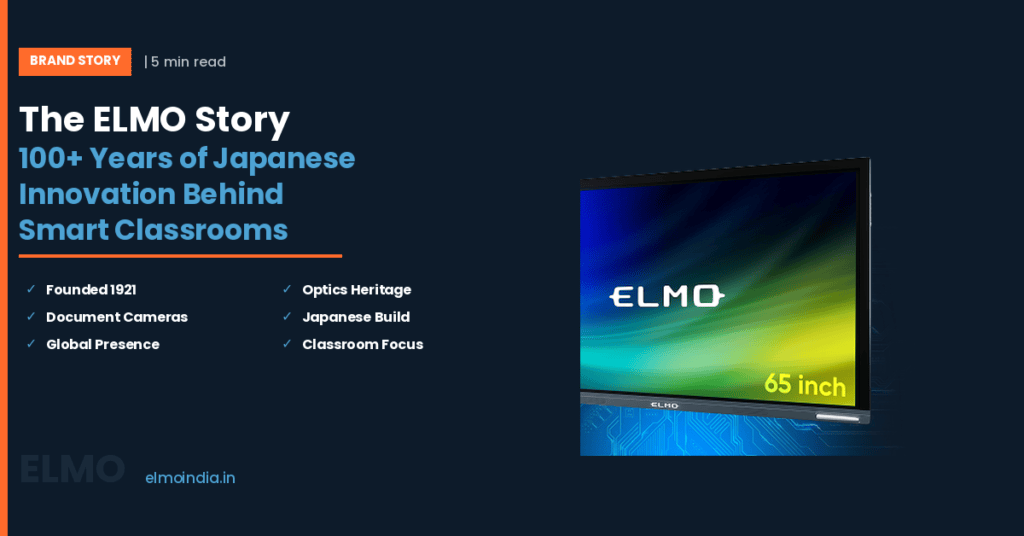
The 65-inch ELMO Board runs 4K UHD at 3840 x 2160, registers 20 simultaneous touch points, and ships on Android 14 with 20W speakers and a 178-degree viewing angle. It is also manufactured in India. Japanese design lineage with a local build is a genuinely useful combination when you are weighing lead times, service response and procurement rules.
The visualiser side of the business is nowhere near retired either. The L12 series turned up at a major literary event in Dubai this year, covered in ELMO Document Camera L12 Series at the 2026 Emirates Airline Festival of Literature — proof that an ELMO document camera earns its keep on a public stage as easily as it does in a Class 7 science lab.
Why a Century-Old Brand Should Matter to an Indian Buyer
Heritage on its own is just marketing copy. What actually transfers to your purchase order is everything a company learns by surviving four format changes in a row — 16mm, 8mm, Super 8, and then digital sensors. ELMO’s official company story reads as a list of pivots rather than a list of trophies, which is the healthier of the two documents to read.
In practical terms, a firm that has been working with optics since 1921 tends to be careful about the parts nobody demos: hinges, lens barrels, glass coatings, thermal design. Those are exactly the components that give way in year three, in a warm classroom running eight hours a day, six days a week, with forty pairs of hands on the panel.
There is a quieter benefit too. A manufacturer that owns both ends of the chain — the camera and the display — can design them to expect each other, instead of leaving a school to make four unrelated brands cooperate on installation day. That kind of integration rarely shows up on a quotation, but it shows up in the first week of teaching.
Then there is the boring question of who is still around in 2032 when you need a spare part or a firmware update. In a category where new interactive panel brands appear and vanish inside a single procurement cycle, longevity is a specification, not a sentiment. ELMO India sells into that reality from Bengaluru, with a Japanese engineering line standing behind the product.
The Short Version
Ask every vendor on your shortlist one blunt question: what were you doing twenty years ago? For a lot of interactive display brands, the honest answer is “existing, briefly.” For this one, it is “the same work, with older sensors.” That century of imaging is exactly why an ELMO Board tends to arrive already understanding what a classroom does to hardware — and why the visualiser sitting beside it comes from the company that helped invent the category in the first place.
—
Frequently Asked Questions
1. Is ELMO a Japanese company, and who owns it today?
Yes, ELMO is Japanese. Since the 2010 merger with Tietech, it has operated under the Techno Horizon Group. Regional arms run their own markets — ELMO USA, ELMO Europe and ELMO India, which works out of HRBR Layout in Bengaluru. So a local purchase gives you Japanese product engineering with an Indian entity handling demos, installation, invoicing and after-sales support.
2. Is the Japanese ELMO brand connected to the Sesame Street character?
No, though the confusion is common enough to muddle your search results. The Japanese company adopted the Elmo-sha name in 1933, as an acronym for Electric Light Machine Organization, roughly five decades before the puppet became a household name. There is no corporate, licensing or naming link between the two. Add "document camera" or "interactive panel" to your searches to filter cleanly.
3. What is the difference between a visualizer, a document camera and a visual presenter?
Functionally, nothing at all — they are three names for one device, and which you hear depends mostly on geography. British and Indian schools usually say visualiser, American schools say document camera, and ELMO's own product literature has long preferred visual presenter. In some classrooms the brand simply became the noun, with teachers telling students to put the page under the ELMO.
4. Are ELMO Boards made in India or imported from Japan?
The ELMO Board interactive panels sold here are manufactured in India, which is why the product pages carry Make in India badging. In practice, local manufacturing shortens delivery timelines on multi-room orders, simplifies service logistics and eases paperwork for institutional and government tenders with local-content conditions. The underlying imaging design and engineering discipline still comes from the Japanese parent company.
5. Does ELMO still make film projectors?
No. Super 8 projector production ended in 1983, and the final models — the GS-1200 P Xenon and P Com — are collector pieces now rather than catalogue items. The current line-up is built entirely around digital imaging: interactive flat panels, document cameras, wireless presentation tools and classroom software. The optical discipline carried across the decades; the film itself did not. —