When schools upgrade their classrooms, two purchases often go together: an electronic board for displaying and interacting with digital content, and a document camera for presenting physical materials. Each device has its own price range and set of specifications — and choosing the wrong combination is a common and expensive mistake. Understanding electronic board price alongside document camera pricing helps schools arrive at a setup that genuinely serves their teaching needs, without overspending on features they will not use or underspending on quality that matters every day.
Electronic Board Price in India — What the Range Means
The Indian market for electronic interactive boards spans a wide price range, and the variation is meaningful — not arbitrary. Here is what each price tier reflects:
₹50,000–80,000: Entry-level electronic boards, typically 55-inch with basic infrared touch, Android OS, and no built-in speakers. Suitable for tight budgets but often have limited warranty coverage and basic processors that slow down with heavy app use.
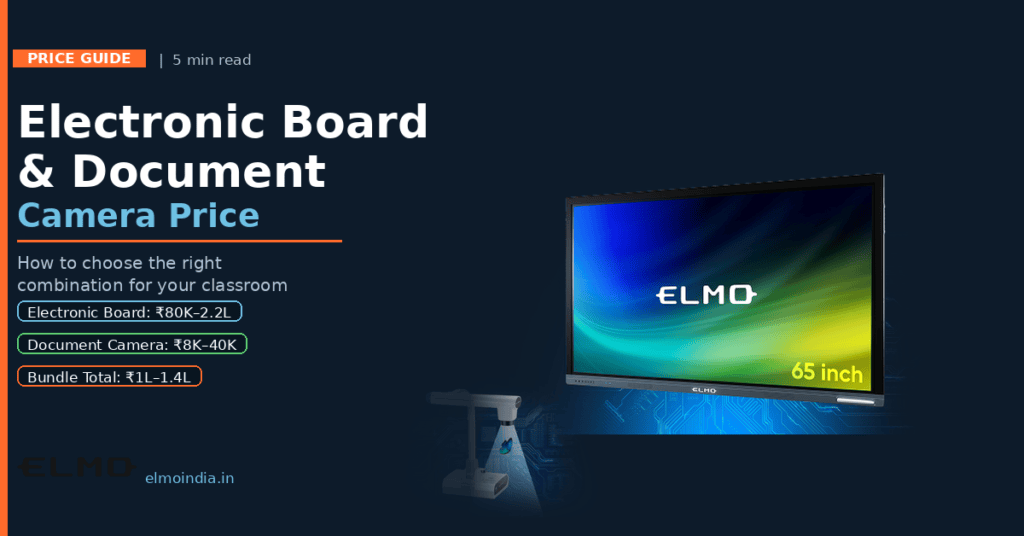
₹80,000–1,30,000: Mid-range 65-inch boards with Full HD or 4K display, Android 11+, IR multi-touch with 10–20 points, built-in speakers, and Wi-Fi. This is the most-purchased range for standard school classrooms in India.
₹1,30,000–2,20,000: Advanced 65–75 inch boards with 4K display, more powerful processors, dual-band Wi-Fi, front-facing cameras, and OPS slots. Well-suited for schools with heavy daily use or hybrid learning requirements.
₹2,20,000–3,50,000+: Premium 75–86 inch large-format panels with the highest touch sensitivity, best display brightness, and enterprise-grade warranties. Appropriate for auditoriums, training centres, and premium school installations.
For a full size-by-size and technology-by-technology breakdown, read our interactive whiteboard price guide.
Document Camera Price in India — Understanding the Range
A document camera (visualiser) is a separate investment that pairs with the electronic board. Document camera prices in India typically range from:
₹8,000–18,000: Basic 2MP USB document cameras. Suitable for displaying printed text and simple documents but inadequate for fine detail in science experiments, specimens, or small student handwriting.
₹18,000–40,000: Mid-range visualisers with 8MP (4K) output, optical zoom, auto-focus, and flexible arm. The ELMO L-12G falls in this tier — a high-performance option for daily classroom use with HDMI and USB connectivity.
₹40,000–80,000: High-end document cameras with wireless output, live annotation, built-in lighting, and 4K+ resolution. Suited for science labs, medical training, and premium corporate training rooms.
For most school classrooms, the ₹18,000–35,000 mid-range tier delivers the resolution and flexibility needed for daily use without the premium features that only specialist environments require.
Choosing the Right Electronic Board and Document Camera Combination
The electronic board and document camera should be chosen together, not as two separate purchases. Compatibility, scale, and use case must align:
The ELMO India classroom bundle — pairing the 65-inch electronic board with the ELMO L-12G document camera — is designed for this sweet spot: secondary school classrooms of 25–35 students. It handles daily textbook display, science demonstrations, student work presentation, and interactive lesson delivery in a single connected setup. See how such setups serve students in our post on how document cameras support inclusive education.
Key Questions to Ask Before Buying
Before confirming any purchase, every school should get clear answers to these questions from the vendor:
Does the document camera connect directly to the electronic board? Check that the camera’s output (HDMI or USB) matches the board’s input. Some boards require an external driver or app to display the camera feed — confirm this works out of the box.
What is the combined warranty and support structure? Ideally, both devices should have service centres in the same city. A board under warranty and a camera out of warranty creates a split support situation that complicates maintenance.
Can the document camera output to the board wirelessly? Wireless visualiser connectivity is increasingly available in mid-range cameras. For schools where the camera and board are on the same Wi-Fi network, this eliminates cable clutter.
Is a demo available for both devices together? Buying an electronic board and document camera without testing them together in a classroom environment is a significant risk. Always request a live classroom demo.
Getting the Bundle Right — Combined Budget Planning
The combined budget for an electronic board and document camera should be planned as a single classroom investment. For most Indian school classrooms, a total budget of ₹1,00,000–1,40,000 covers a well-specified 65-inch digital class board and a quality mid-range document camera — with installation included. This replaces the projector, screen, whiteboard, and overhead projector in one streamlined, low-maintenance setup.
Schools on tighter budgets should prioritise the electronic board quality over the document camera — a good board with a basic camera is far more useful than a premium camera connected to a poorly performing board. For more on the financial case, read our analysis of why smart boards are worth the investment in Indian schools.
Buy the Combination, Not Just the Devices
An electronic board and document camera that work seamlessly together deliver more classroom value than either device used alone. Plan the purchase as a combined classroom upgrade — matching screen size to room dimensions, camera resolution to teaching depth, and both devices’ connectivity standards to each other. ELMO India offers a classroom-tested pairing of electronic board and document camera designed for Indian school conditions. Contact the team for a combined quote and demo.
FREQUENTLY ASKED QUESTIONS
Q1: What is the price of an electronic interactive board in India?
Electronic interactive board prices in India range from ₹50,000 for basic 55-inch entry-level models to ₹3,50,000+ for premium 86-inch large-format panels. The most commonly purchased range for school classrooms is ₹80,000–1,30,000, covering 65-inch boards with Android OS, infrared multi-touch, Full HD or 4K display, and built-in speakers. Prices vary based on size, touch technology, resolution, and warranty terms.
Q2: How much does a document camera cost in India for classroom use?
Document cameras for classroom use in India are typically priced between ₹8,000 and ₹40,000. Basic USB cameras start from ₹8,000–15,000 and are suitable for simple document display. Mid-range visualisers with 8MP (4K) output, optical zoom, auto-focus, and flexible arm connectivity are priced from ₹18,000–35,000. These mid-range cameras are the right choice for most secondary school classrooms. High-end wireless 4K cameras for labs and training rooms can cost ₹40,000–80,000.
Q3: Can a document camera connect to any electronic board?
Most document cameras connect via HDMI or USB and are compatible with standard electronic boards that have these input ports. However, compatibility is not guaranteed — some boards require specific drivers or apps to display camera input. Always verify the connection chain before purchase: confirm that the document camera’s output standard (HDMI 1.4, USB-C, etc.) matches the board’s available input ports, and test the live feed during the demo.
Q4: What is the difference between an electronic board and a smart board?
The terms are often used interchangeably, but there is a nuance. An electronic board refers broadly to any digitally interactive display — including basic touch displays without built-in computing. A smart board specifically refers to an interactive display with an integrated processor, operating system (usually Android or Windows), internet connectivity, and app support. For school classroom use, a smart board with built-in Android OS is significantly more useful than a basic electronic board that requires an external PC.
Q5: Should schools buy an electronic board and document camera from the same brand?
Buying from the same brand is generally beneficial for compatibility, single-vendor support, and warranty management. Mixed-brand setups can work but may require manual compatibility verification and create complications if both devices need servicing simultaneously. For schools where budget allows, purchasing a matched electronic board and document camera from a single vendor — like the ELMO India classroom bundle — simplifies procurement, support, and long-term maintenance.