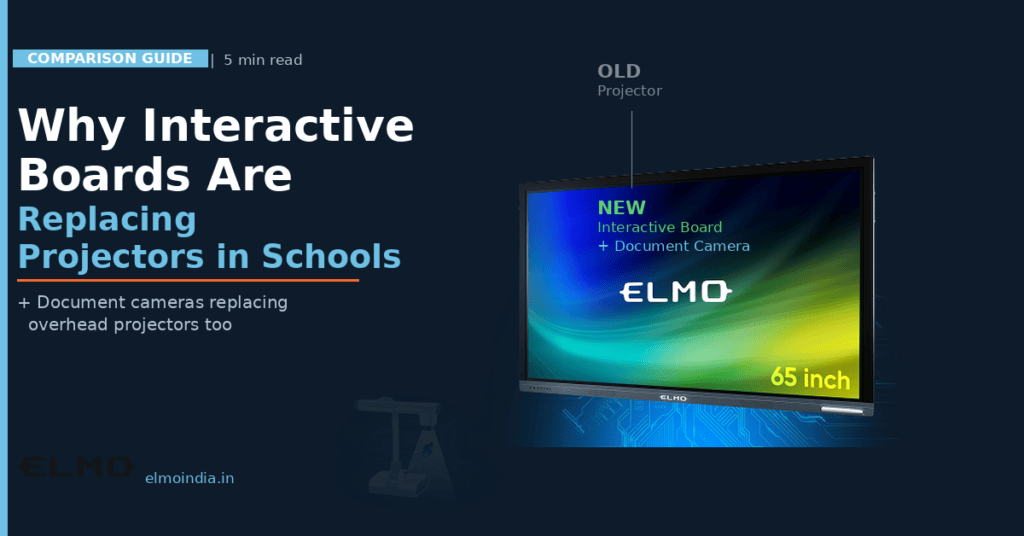
The classroom projector — once considered a major step forward in education technology — is now being retired at scale across schools in India and globally. More than 4.6 million interactive whiteboards are already installed in schools worldwide, and the shift is accelerating. Interactive boards for classrooms do not simply replace projectors — they eliminate most of the problems that projectors never solved. Paired with a document camera, they create a genuinely complete digital teaching environment. This blog explains exactly why this transition is happening and what it means for schools still considering the switch.
The Limitations That Finally Caught Up with Projectors
Projectors entered classrooms as a practical solution for displaying digital content at scale. But they came with a set of limitations that teachers have tolerated for years — and are no longer willing to accept:
Shadow disruption: Any movement between the projector lens and the screen creates shadows, interrupting lessons. Teachers who write on the board or demonstrate near the screen constantly deal with this problem.
Daylight washout: Projector images lose contrast and visibility in rooms with natural light or open windows — a common situation in Indian classrooms that lack blackout curtains.
Calibration and alignment: After any movement or bump, projectors require realignment. This eats into teaching time and frustrates teachers.
Lamp replacement cost: Projector lamps last 3,000–5,000 hours and cost ₹5,000–15,000 to replace — a recurring expense that adds up across a school’s fleet.
No interactivity: A projector-and-screen setup is one-directional. Students watch; they cannot participate, annotate, or interact with what is displayed.
What Interactive Boards Offer That Projectors Cannot
An interactive board for classroom use replaces the entire projector-screen-whiteboard setup with a single device. The display is self-lit — no external light source needed — with brightness ratings of 400 nits or more that make the image clear even in well-lit rooms. There are no shadows, no calibration steps, and no consumable costs like lamp replacements.
Beyond the hardware advantages, the interactive board changes what teaching can look like. Teachers write and annotate directly on the screen in real time. Students come to the board to solve problems, label diagrams, or build mind maps. Lessons saved digitally are available immediately after class. The board connects to the internet, runs apps, and mirrors student devices wirelessly.
Read our detailed post on how interactive boards improve classroom engagement for a deeper look at how this plays out in daily teaching.
Why Document Cameras Are Replacing Overhead Projectors
Alongside interactive boards, the document camera — also called a visualiser — is replacing the overhead projector that many Indian schools still use for displaying physical materials. A document camera provides several advantages that an overhead projector cannot:
Live, high-resolution capture: Document cameras capture 4K-quality images of documents, student work, 3D objects, and even microscope slides — displayed instantly on the interactive board.
No heat or UV: Overhead projectors generate significant heat and UV light. Document cameras are cool-running LED devices — safer for handling books and specimens.
Flexible arm: A document camera’s adjustable arm can point at any surface, any angle, and any object — far beyond the flat-surface limitation of overhead projectors.
Digital recording: Document cameras can record demonstrations as video that teachers share with students after class — something overhead projectors cannot do.
The ELMO L-12G visualiser is built specifically to pair with interactive boards, enabling a complete digital classroom environment. See our post on how document cameras support inclusive education for a broader perspective on their classroom value.
The Real Cost of Keeping Old Technology
Schools that delay replacing projectors often justify the decision as cost-saving. In reality, maintaining ageing projectors is expensive. A school running 10 projectors with average lamps replaced once every 18 months spends ₹50,000–1,50,000 per year on lamp replacements alone — before factoring in servicing costs, teacher time lost to setup, and the engagement opportunity cost of passive, non-interactive lessons.
An interactive board at ₹1,00,000–1,50,000 with a 7-year lifespan and zero consumable costs often represents a lower total cost of ownership over five years than continuing to maintain a projector fleet. Our analysis of why smart boards are worth the investment in Indian schools provides the full cost comparison.
Side-by-Side Comparison: Projector vs. Interactive Board vs. Document Camera
How Indian Schools Are Making the Switch
The most common transition model in Indian schools is a phased replacement: starting with one or two high-use classrooms, training teachers on the new system, and then expanding board by board as budget allows. This approach reduces disruption and gives teachers time to integrate the technology into their lesson planning before a full-school rollout.
According to Samsung Business Insights research on upgrading from projectors to interactive boards, schools that involve teachers in the selection process — rather than making top-down purchases — report significantly higher adoption rates in the first year. ELMO India’s smart classroom solutions include teacher onboarding support designed to make this transition smooth across school types.
The Classroom Has Moved On
Traditional projectors served their purpose, but interactive boards for classrooms and document cameras offer a fundamentally better teaching environment — brighter displays, zero shadows, full interactivity, and no recurring lamp costs. The shift is not a trend — it is a permanent upgrade to how classrooms work. Schools evaluating this transition today are making an investment that will serve teachers and students for the next decade. Explore the full ELMO India interactive board and document camera range to find the right combination for your school.
FREQUENTLY ASKED QUESTIONS
Q1: Why are schools replacing projectors with interactive boards?
Schools are replacing projectors because interactive boards eliminate the core problems projectors never solved — shadow disruption, daylight washout, lamp replacement costs, and complete lack of interactivity. An interactive board is a self-lit, touch-enabled display that works in any lighting condition, requires no consumables, and enables students to participate actively rather than watch passively.
Q2: Can an interactive board completely replace a projector and a whiteboard?
Yes. An interactive board is a combined replacement for the projector, screen, and whiteboard. It displays digital content, plays video, connects to the internet, and functions as a full whiteboard where teachers and students can write, draw, and annotate directly on the screen with a stylus or finger. There is no need for a separate screen or traditional whiteboard once an interactive board is installed.
Q3: What is the difference between a document camera and an overhead projector?
An overhead projector uses light transmission through transparent acetate sheets to display flat images — it generates heat and is limited to flat, transparent materials. A document camera uses a high-resolution digital camera to capture and display any object — books, 3D specimens, student work, handwritten notes — in real time at 4K resolution. It is cooler, more flexible, and produces far sharper images than any overhead projector.
Q4: How long does an interactive board last compared to a projector?
A quality interactive board has a display lifespan of 50,000+ hours (equivalent to over 25 years at 5 hours per day), whereas projector lamps last only 3,000–5,000 hours and require replacement. The LED-backlit panels in modern interactive boards have no consumable components to replace, making them significantly more durable and lower-cost to maintain over time.
Q5: Do teachers need special training to use interactive boards?
Basic usage of an interactive board — writing, displaying content, connecting a laptop — takes most teachers less than one hour to learn. Advanced features like running quiz apps, wireless screen mirroring, and collaborative board exercises benefit from a half-day training session. Schools that invest in teacher training during rollout consistently report higher and more effective board usage than those that simply install the hardware without onboarding.