Schools across India are actively replacing chalkboards and projectors with interactive technology — but the wide variation in digital board for teaching price causes real confusion during purchase decisions. A board priced at ₹60,000 and one priced at ₹2,00,000 can look identical in a brochure but perform very differently in a classroom. Understanding what drives the price — and what each price tier actually delivers — is the difference between a good investment and an expensive mistake. This guide breaks down pricing in the Indian market clearly, covering what each budget gets you, what costs are commonly missed, and what schools should prioritise when evaluating options.
What Does a Digital Board for Teaching Cost in India?
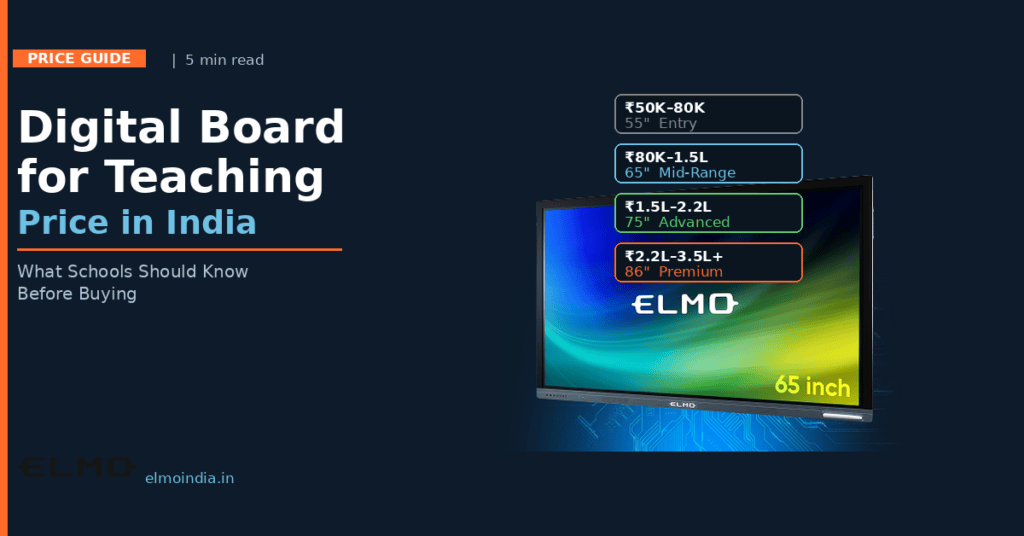
The Indian market for digital teaching boards is broad, with prices ranging from approximately ₹50,000 for basic entry-level units to over ₹3,50,000 for premium large-format panels. The most common purchase range for government-aided and private schools falls between ₹80,000 and ₹1,50,000, covering 65-inch mid-range boards with full Android OS, multi-touch, and Wi-Fi.
Here is a practical breakdown of what each price tier delivers in 2025–26:
What Drives the Price of a Digital Board?
Not all digital boards are priced the same for the same reason. Several technical factors directly determine the cost:
Screen size: Each step up in display size (55″ to 65″ to 75″ to 86″) adds ₹40,000–70,000 to the base price. Larger schools or those with more than 30 students per class generally require 75″ or above for rear-row visibility.
Touch technology: Infrared (IR) touch is the most affordable and widely used. Optical touch and capacitive touch (PCAP) offer finer precision but add cost. Most mid-range boards use IR with 10–20 touch points.
Resolution: Full HD (1080p) is standard at mid-range. 4K resolution improves detail on large screens but adds ₹15,000–30,000 to the price.
Operating system: Android-only boards are more affordable. Dual-OS boards (Android + Windows) or Windows-only boards cost significantly more but offer richer software compatibility.
Built-in features: Integrated speakers, microphones, front cameras, and OPS (Open Pluggable Specification) slots for PC modules increase the unit price.
Hidden Costs Schools Often Overlook
The sticker price on a digital board rarely represents the full investment. Schools frequently underestimate additional costs that appear after purchase. Our post on why upgrading to a digital blackboard saves money long term addresses the full picture, but here are the main hidden costs to account for:
Installation and wall mounting: ₹3,000–10,000 depending on wall type and room layout.
Annual Maintenance Contract (AMC): Typically ₹8,000–20,000 per year depending on the brand.
Replacement styluses and accessories: Often not included in base price.
Teacher training and onboarding: Many schools overlook this, but untrained teachers underuse the technology.
Content or software licences: Some boards require proprietary platforms that carry annual fees.
Accounting for these items, a ₹1,00,000 board can realistically cost ₹1,20,000–1,30,000 in the first year once installation and initial AMC are included.
How Indian Schools Should Set Their Budget
A practical approach is to budget by classroom size and intended use. For a standard classroom of 25–35 students, a 65-inch board in the ₹90,000–1,30,000 range typically delivers the right balance of screen size, resolution, and touch responsiveness. The ELMO 65-inch interactive board is specifically designed for this classroom profile and is a reliable benchmark for what a mid-range classroom board should deliver.
Schools building a multi-classroom rollout should also explore volume pricing. Vendors typically offer 10–15% discounts on orders of five or more units, which can significantly lower per-unit cost. Government schools under NEP digital infrastructure initiatives may also qualify for subsidised procurement through state education departments.
For schools with tighter budgets, our guide on how to choose a smart touch board on a budget covers how to identify good-value options without compromising on daily teaching utility.
Price vs. Value — What Matters More Than the Number
The smartest purchases in this category are rarely the cheapest or the most expensive — they are the ones where the board’s capabilities match the school’s daily teaching workflow. A board with excellent touch responsiveness, reliable Android software, and a 3-year on-site warranty at ₹1,10,000 is better value than a ₹75,000 board that requires calibration every week or loses connectivity regularly. Read the comparison in our blog on how much does an interactive board cost for schools vs corporates for a deeper view on value-based purchasing.
Three factors determine long-term value in any digital teaching board: build quality of the display panel, reliability of the touch layer, and quality of after-sales support. Schools that evaluate vendors on these three points — not just the unit price — consistently report higher satisfaction with their investment two to three years after purchase.
Making the Right Investment
Understanding smart board for teaching price in India is not just about finding the lowest number — it is about matching the right product to your classroom’s real needs and budget. Factor in screen size, touch technology, hidden costs, and vendor support before finalising any purchase. ELMO India offers a range of classroom-tested interactive boards with transparent pricing and genuine after-sales support across India. Reach out to the ELMO India team for a school-specific quote and demo.
FREQUENTLY ASKED QUESTIONS
Q1: What is the average price of a digital board for teaching in India?
The average price of a mid-range digital board for teaching in India is between ₹80,000 and ₹1,50,000 for a 65-inch panel with Android OS, multi-touch, and Wi-Fi. Entry-level 55-inch boards start from approximately ₹50,000, while premium 75-inch and 86-inch boards can cost ₹1,50,000 to ₹3,50,000+. Prices vary by brand, features, and whether the installation and AMC are included.
Q2: What size digital board is most popular for school classrooms in India?
The 65-inch digital board is the most widely purchased size for school classrooms in India. It offers good visibility for classes of up to 35 students, fits within the ₹80,000–1,50,000 budget range that most private schools target, and is available from the widest range of brands. Schools with larger classrooms or more than 35 students per room typically prefer 75-inch or 86-inch panels.
Q3: Does GST apply to digital boards for schools in India?
Yes, digital interactive boards attract 18% GST in India. Prices quoted by vendors are sometimes exclusive of GST, so it is important to confirm whether the listed price is GST-inclusive or exclusive before comparing quotes. For government schools procuring boards through government tenders or education ministry schemes, GST exemptions or input tax credits may apply — consult a tax advisor for specifics.
Q4: What is included in the price of a digital teaching board?
Standard inclusions vary by vendor but typically include the display panel, wall mounting bracket, two stylus pens, power cable, HDMI cable, and basic warranty. Items that are often not included are installation labour, annual maintenance contracts (AMC), protective sleeves or screen guards, and software licences. Always request a complete itemised quote from the vendor before confirming an order.
Q5: Can a school buy a digital board under ₹1 lakh?
Yes, functional digital boards for teaching are available under ₹1 lakh in India. In the ₹70,000–1,00,000 range, schools can expect a 65-inch board with Full HD resolution, Android OS, infrared multi-touch, and basic Wi-Fi. However, at this price point, buyers should carefully verify the warranty terms, after-sales service availability in their city, and whether the board supports 10+ touch points for interactive teaching.